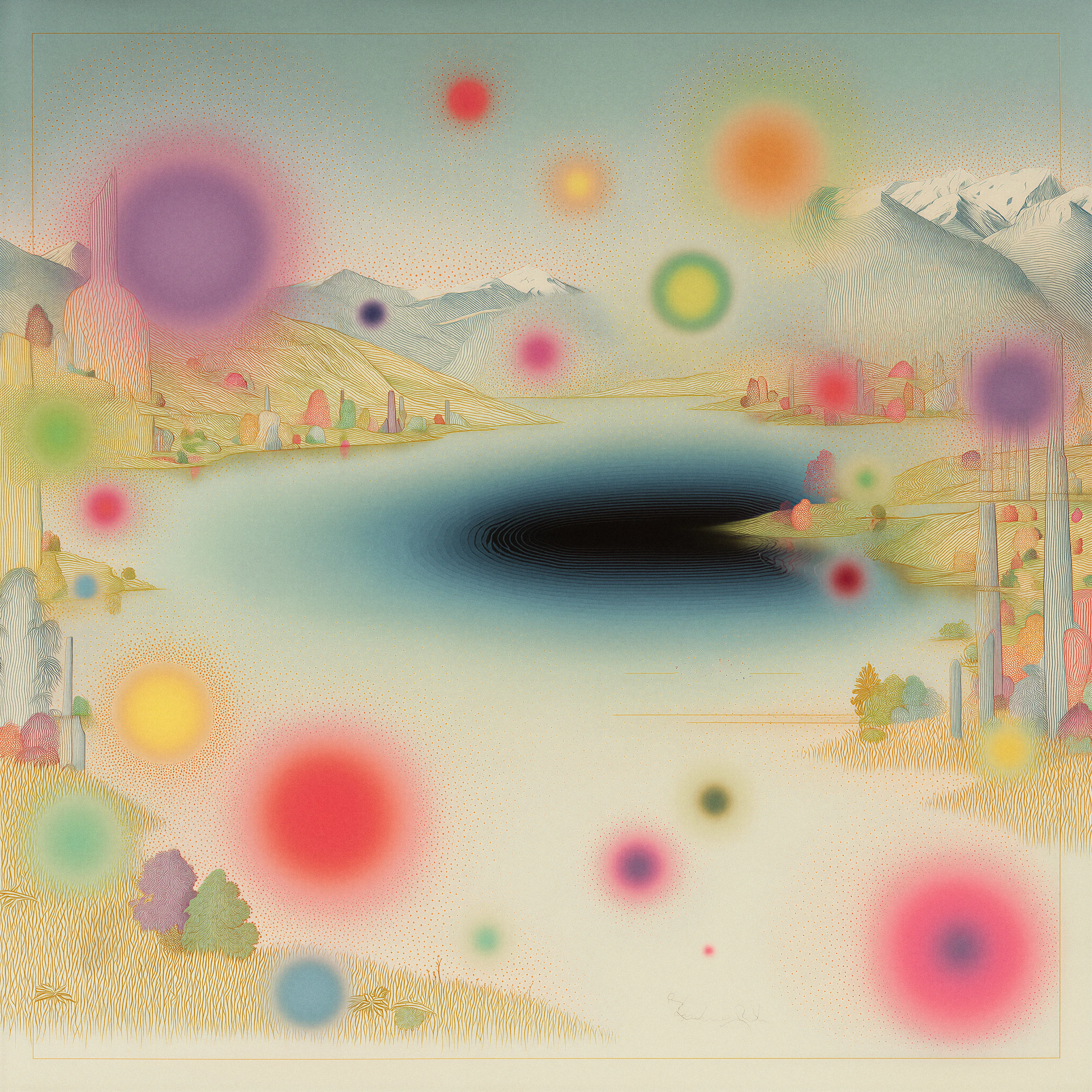
She had been mapping the valley for eleven years when she understood that the lights were not reflections.
At first, Marta attributed them to the altitude, to the thin air that made breath a negotiation and vision a faith. The locals called the valley O Berço Vazio—the Empty Cradle—and spoke of it the way one speaks of a relative who has done something unforgivable: without specifics, with lowered eyes.
The surveying commission had sent her alone. This should have been her first warning. Cartographers work in pairs, the way divers do, the way those who enter caves do. But the commission's letter had been singular: You will document what remains.
What remained was this: a lake that absorbed light rather than reflecting it, hills rendered in the fine script of dead grasses, and the lights. Always the lights. They drifted through the air like questions asked in an empty room, these spheres of color that seemed to exist slightly beside themselves, as if they had arrived from somewhere that operated under different geometric principles.
Marta pitched her equipment on the southern ridge and began her measurements. Theodolite. Chain. Compass. The instruments of certainty. But the valley resisted quantification. Distances changed between morning and afternoon. The lake's circumference varied by meters depending on whether she measured walking clockwise or against. Her notebooks filled with numbers that contradicted each other, yet each measurement had been taken with precision.
By the third month, she stopped eating with the villagers. Not by choice—they simply stopped opening their doors when she knocked. She would see them watching from windows, their faces carrying an expression she initially mistook for fear but later recognized as something closer to pity.
They are waiting for you to see, said the old woman who sold her bread through a half-opened shutter. Everyone who stays long enough eventually sees.
Marta did not ask what. She had learned that questions in this place functioned differently—they did not seek answers but rather opened spaces where answers had once been.
The lights began visiting her tent on the night of the first frost.
She woke to find one hovering near her face, the color of a wound that is healing. It pulsed with something that was not quite warmth, not quite sound, but occupied the same territory in her perception. She did not scream. She had unlearned screaming during her third year in the valley, when she realized that silence was the only vocabulary the place understood.
The light remained for seven minutes—she counted, because counting was all she had left—then drifted through the canvas as if the tent were merely a suggestion.
After that, they came regularly. Pink ones. Amber ones. A deep violet that reminded her of the bruise on her mother's wrist the last time she had visited, the one neither of them mentioned. She began to recognize them individually, not by color but by weight. Each carried a different kind of heaviness.
She wrote in her margins: The lights are not illumination. They are the opposite. They are what remains when illumination departs.
In her seventh year, Marta stopped sending reports to the commission.
Their letters arrived with decreasing frequency until they ceased entirely, and she understood that she had become one of those surveyed rather than the surveyor. Her measurements grew less rigorous. She would sit for hours at the edge of the lake—that spiral of darkness that seemed to descend forever into something that was not water—and watch the lights drift across the valley like thoughts crossing a mind that had forgotten what thinking was for.
The locals, those who remained, began leaving food at her tent's entrance. They never knocked. The food appeared at dawn, still warm, wrapped in cloth that smelled of woodsmoke and something older. She ate without tasting, grateful for the calories, disturbed by the charity.
One morning, she found a mirror among the offerings.
She had not looked at her reflection in three years. The valley had no still water—the lake's surface moved constantly, those slow concentric ripples that pulsed outward from its center—and she had broken her compact mirror during a fever in her fourth winter.
The face that looked back at her was familiar the way a childhood home is familiar after decades away: the structure remained, but the meaning had shifted. Her eyes had developed a quality she could not name, something between transparency and depth, as if they had learned to let light pass through rather than stopping it.
You are becoming, she wrote that night. She did not finish the sentence because she did not know the object. Becoming what? The valley had taught her that some transformations have no destination, only departure.
The revelation, when it came, arrived without drama.
She was measuring the distance between two pines—an act of nostalgia more than science, a ritual performed to remember what purpose had once felt like—when she noticed that one of the lights had stopped moving. It hovered near a boulder she had measured a hundred times, its yellow glow casting no shadow.
And then she understood.
The light was not floating near the boulder. The light was the boulder. Or rather, the light was what remained of something that had once been where the boulder stood. The boulder was an echo, the light was the voice.
She looked at the valley with new eyes—those eyes that had learned transparency—and saw it finally: every light marked an absence. Here, a house had stood. There, a child had played. The amber light near the lake's edge was a woman who had walked there every morning for sixty years. The violet near her tent was a dog that had once belonged to the shepherd whose bones she had found in her second spring, tucked beneath an overhang as if sleeping.
The valley was a cemetery of presences, and the lights were not ghosts but the space that ghosts would occupy if ghosts were made of something as crude as matter.
They are holes in the shape of what was, she wrote. And I have been mapping the wrong dimension entirely.
In her eleventh year, Marta set down her instruments.
She walked to the lake's edge, where the spiral pulled vision downward into its infinite regression, and she sat. The lights gathered around her, as they did every evening now, and she felt their weight settle against her skin like snow, like sorrow, like the particular exhaustion of having finally understood something that could not be spoken.
She was not the cartographer. She never had been. She was the thing being mapped.
The commission had known. The village had known. Perhaps she had known too, in that part of herself that had stopped resisting the valley's logic years ago. She was here to become one of the lights. To take her place in the grammar of absence that the valley spoke.
The loneliness had not been a failure of connection. It had been preparation. To become a light, one had to first become empty. One had to let the present drain away until only the residue of having-been remained.
She watched the last of the autumn sun catch the peaks of the distant mountains—those mountains she had never reached, would never reach—and she felt herself beginning to thin at the edges.
This is not death, she thought. This is translation.
The lights pulsed around her in colors that had no names, and she understood that they were not mourning her arrival but welcoming it. She would join their congregation of absences, their church of the departed-but-remaining.
Her final entry, found years later by another surveyor who would begin her own eleven years of preparation, read simply:
The empty cradle is not empty. It holds what rocking would have meant.
In the valley, a new light appeared that winter. It was the color of ink, of measurement, of certainty that has finally surrendered. It drifted near the lake's eastern shore, where a tent still stood, where instruments rusted in their cases, where a mirror lay face-down in the grass, reflecting nothing because there was nothing left that needed to be seen.
The locals added her to their silence.
The commission sent another letter, singular, inevitable:
You will document what remains.